How much can I pay on my credit card this paycheck?
The safe amount is what's left after everything due before your next payday, plus a small cushion. Here's the five-step math, a worked example, and why the number changes during the week.

Take your checking balance, subtract every bill and minimum payment due before your next paycheck, set aside everyday spending until then, and keep a small cushion. What's left is the most you can safely put toward a credit card today. If the result is zero or less, pay the minimums and stop there.
Why this is harder than it sounds
If you carry more than one card, the minimums move every month. Statements close on different days. A bill you forgot about lands on a Thursday.
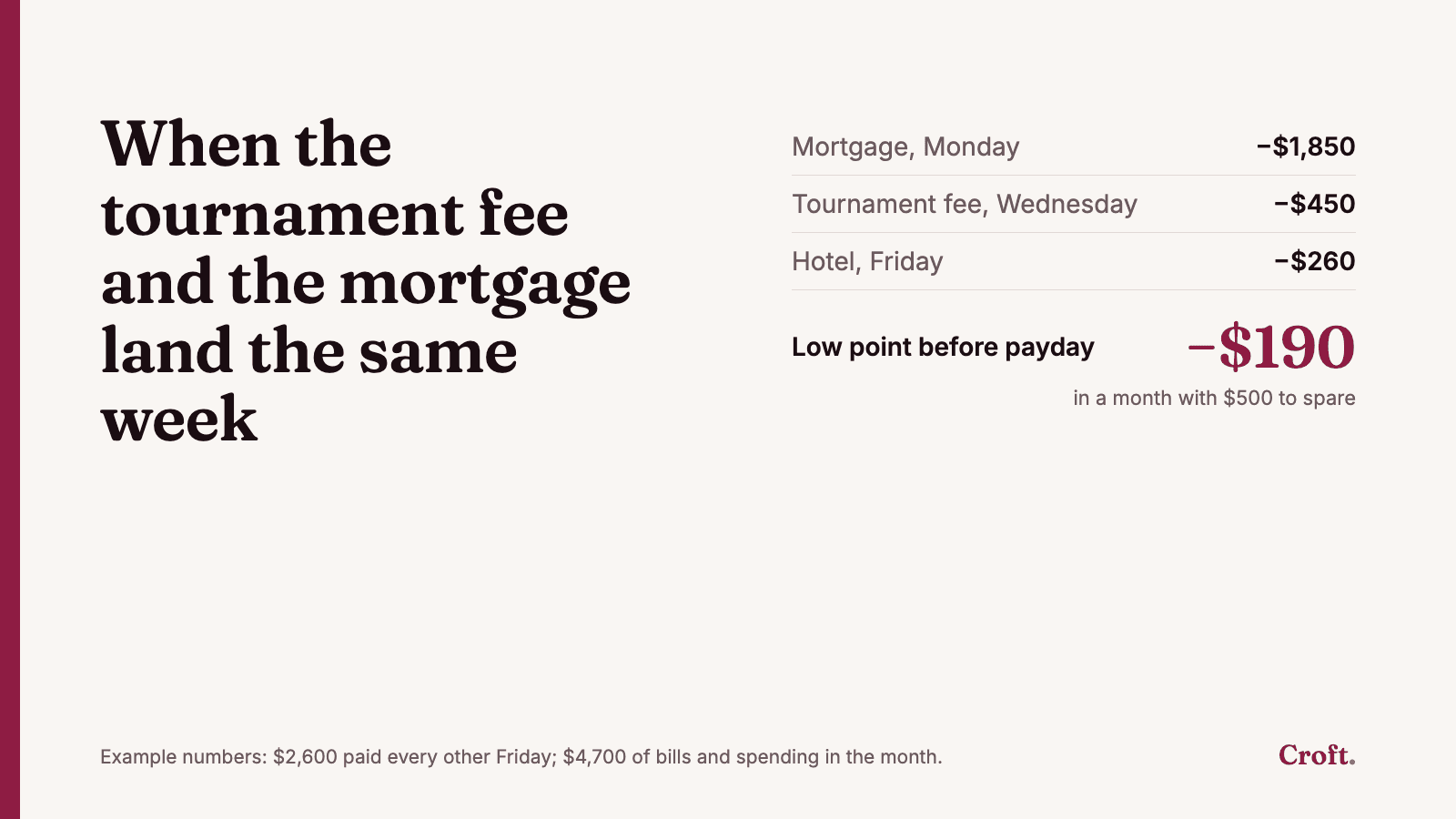
Pay too much on payday and you can come up short before the next one. Pay too little and the money sits in checking while the interest keeps growing.
I built Croft because I was updating a spreadsheet every time a minimum changed, just to answer this one question. The math itself is simple. Keeping it current is the hard part.
The five-step math
Start with what's in checking right now. Include this paycheck only if it has already landed.
List every bill due before your next payday. Rent, utilities, phone, insurance, childcare, subscriptions.
Add every minimum payment due before your next payday. Each card and each loan.
Set aside everyday spending until payday, like groceries and gas, plus a small cushion for the surprise copay or late fee.
What's left is your safe extra. Put it toward one card, usually the one with the highest interest rate.
A worked example
Example numbers, not a real account. Payday was Friday, and the next one is in 14 days.
Checking today: $2,400
Bills before next payday: rent $950, phone $65, car insurance $140. Total $1,155
Card minimums before next payday: Card A $45, Card B $38. Total $83
Everyday spending until payday: $400
Cushion: $200
$2,400 − $1,155 − $83 − $400 − $200 = $562 safe extra.
Card B charges 27.99% and Card A charges 19.99%, so the $562 goes to Card B, on top of its $38 minimum.
Why the number changes during the week
The answer isn't set once per payday. It's the answer for right now, and it moves when:
a bill posts a day earlier or later than expected;
a card statement closes and its minimum changes;
a refund lands, or a bill gets paid in two parts instead of one.
Before you send a big extra payment, check the number again that day.
Which card should get the extra?
Paying the minimum on every card and putting the whole extra on the card with the highest interest rate saves the most money. If a card has a 0% promotional rate, make sure it's paid off before the promo ends, or the regular rate can kick in on what's left.
Some people prefer to clear a small balance first because it feels like progress. That works too. It just costs a little more interest.
Questions people ask
Should I pay my credit card on payday or on the due date?
Either works if the payment arrives by the due date. Paying on payday makes sure the money goes to the card before it gets spent. Paying closer to the due date keeps more cash on hand for surprises. What matters is that every minimum is paid on time and the extra doesn't leave you short before your next paycheck. More on payday vs due date
How big should my cushion be?
Big enough to cover a typical surprise before payday without touching savings. Many people start with $100 to $300 and adjust after a month or two of seeing how low their checking actually goes.
Is it better to put the extra on one card or spread it out?
Pay the minimum on every card, then put all of the extra on one card, usually the one with the highest interest rate. Spreading it evenly costs more interest over time.
What if my safe extra is zero?
Pay every minimum on time and skip the extra this paycheck. That isn't falling behind. It's what keeps you from overdrafting or adding new card balances before payday.