When the tournament fee and the mortgage land the same week
Your month can add up and your checking can still go negative before payday. Here's why timing beats totals, a worked example with a −$190 low point in a month with $500 to spare, and three ways to fix a bad week.

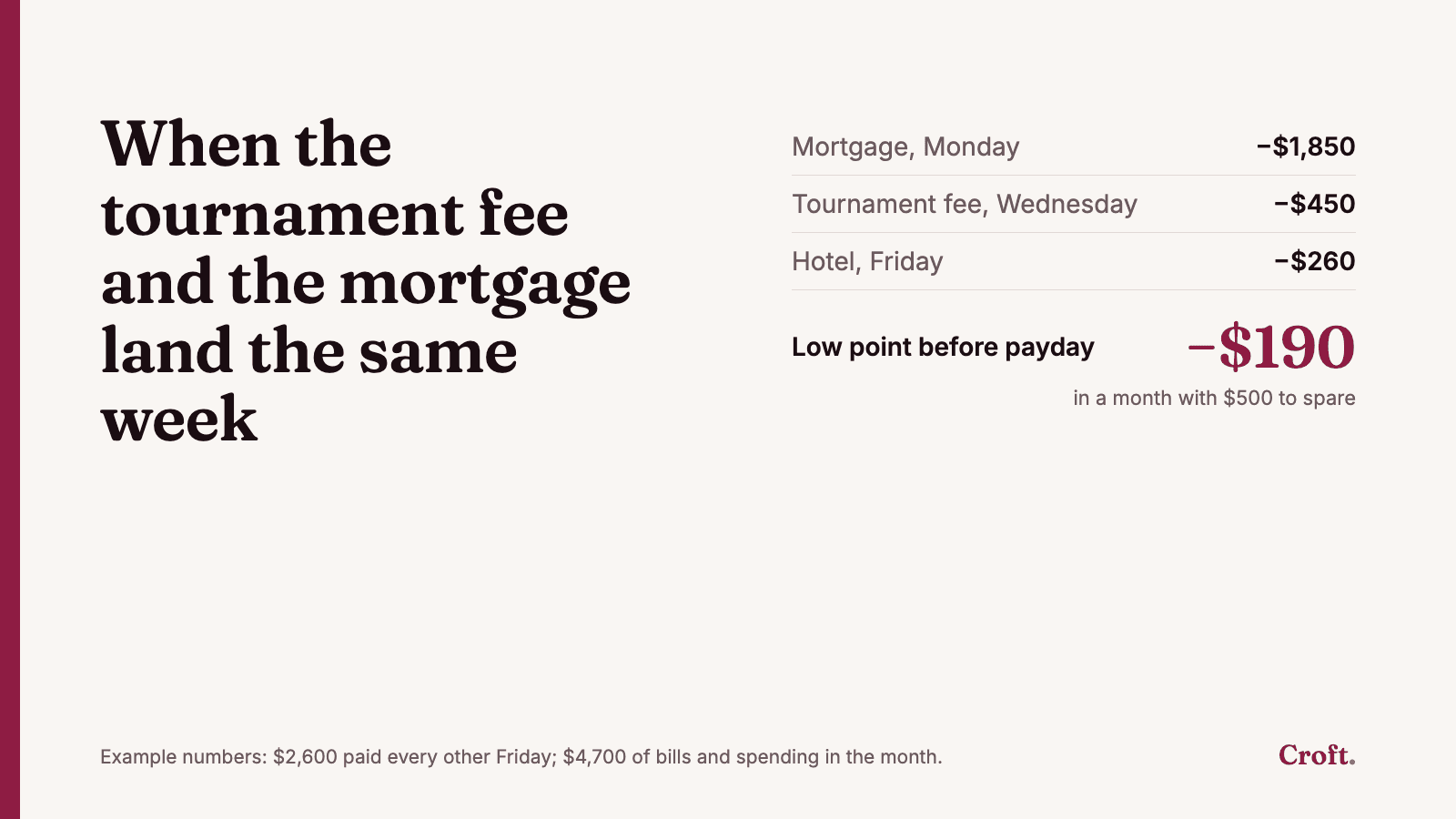
When the tournament fee and the mortgage land in the same week, the problem is timing, not your total. Your month can add up and your checking can still dip below zero before payday. Find the lowest your balance gets between paychecks, and the day it happens. Then move money or a date so it stays above a cushion.
You're not bad with money. You're busy. Two kids, practice three nights a week, a hotel two towns over on Saturday. Nobody has time to walk their checking account forward day by day. So here's the short way to do it, with an example week.
Why a month that adds up can still come up short
Most budgets are built on totals. Money in this month, money out this month. If in is bigger than out, you're fine.
But bills don't come out in a total. They come out on dates. A mortgage on the 1st, a team fee on the 3rd, a hotel on the 5th. Your paycheck comes out on a date too, and it doesn't care what's due before it.
So a month can be fine on paper and still have one bad week. That week is where the overdraft fee, the late fee or the card swipe "just this once" happens.
Example: a month with $500 to spare that still goes negative
These are example numbers. Say you're paid $2,600 every other Friday, so $5,200 lands this month. Your bills and spending for the month come to $4,700. That leaves $500 to spare.
Here's how the first two weeks play out, starting with $300 in checking before payday:
Day | What | Amount | Balance |
|---|---|---|---|
Friday | Paycheck | +$2,600 | $2,900 |
Monday | Mortgage | −$1,850 | $1,050 |
Tuesday | Groceries | −$180 | $870 |
Wednesday | Tournament fee | −$450 | $420 |
Thursday | Car insurance | −$140 | $280 |
Friday | Hotel for the weekend | −$260 | $20 |
Saturday | Gas and food at the tournament | −$120 | −$100 |
Monday | Phone bill | −$90 | −$190 |
Friday | Next paycheck | +$2,600 | $2,410 |
The first two weeks carry $3,090 of the month's $4,700. The second two weeks carry only $1,610. Same month, same $500 to spare. But the balance hits −$190 on the second Monday.
That −$190 is the low point: the lowest your checking gets before your next paycheck. It's the number that matters, and the month's total hides it.
Three ways to fix a bad week
You don't need to cut $190 from your life. You need to move $190, or more, out of the wrong week. Pick the one that fits.
1. Set it aside from the paycheck before. The tournament fee was known weeks ago. If $450 had come out of the previous paycheck and sat in checking, this week would start at $750 instead of $300. The low point moves from −$190 to $260.
2. Pay one thing from the next paycheck. If the hotel lets you pay at check-out, or the league takes the fee in two parts, part of the week's load moves past payday.
3. Move a due date. Some lenders, insurers and phone companies will change your due date if you ask. Moving the $140 car insurance to the week after payday takes it out of the tight week for good.
Any one of these keeps the account above zero. Two of them together leave a real cushion.
How to find your low point in 10 minutes
You need your checking balance, your next two paydays, and the bills and plans you already know about.
Write today's balance at the top.
List every bill and planned cost until your next paycheck, in date order. Include the ones that aren't bills: the fee, the hotel, gas for the drive, food at the tournament.
Add any purchases that haven't posted yet. The swipe from last night may not show up for a day or two.
Walk the balance down, one line at a time. Write the new balance next to each line.
Circle the lowest number. That's your low point, and the date next to it is your tight day.
Compare it to your cushion. If the low point is below the cushion you want to keep, use one of the three fixes above before the week starts.
If you want the longer version of this method, our post on what's safe to spend before payday walks through it step by step.
Plan the season, not just the week
Travel sports don't have one tight week. They have a season of them. A few habits make the whole season easier:
Put the season's dates on one list. Sign-up fees, tournament weekends, hotel nights, uniforms. Write them down the day the schedule comes out.
Match each one to a paycheck. Ask "which paycheck pays for this?" for every date. If two big costs land on the same paycheck, move one back a paycheck by setting it aside early.
Watch the weeks the big bills hit. Mortgage week, insurance week and the week a card minimum comes out are the weeks a tournament fee hurts most.
Leave room for the surprise tournament. Teams make playoffs. A cushion is what keeps that good news from turning into a card balance.
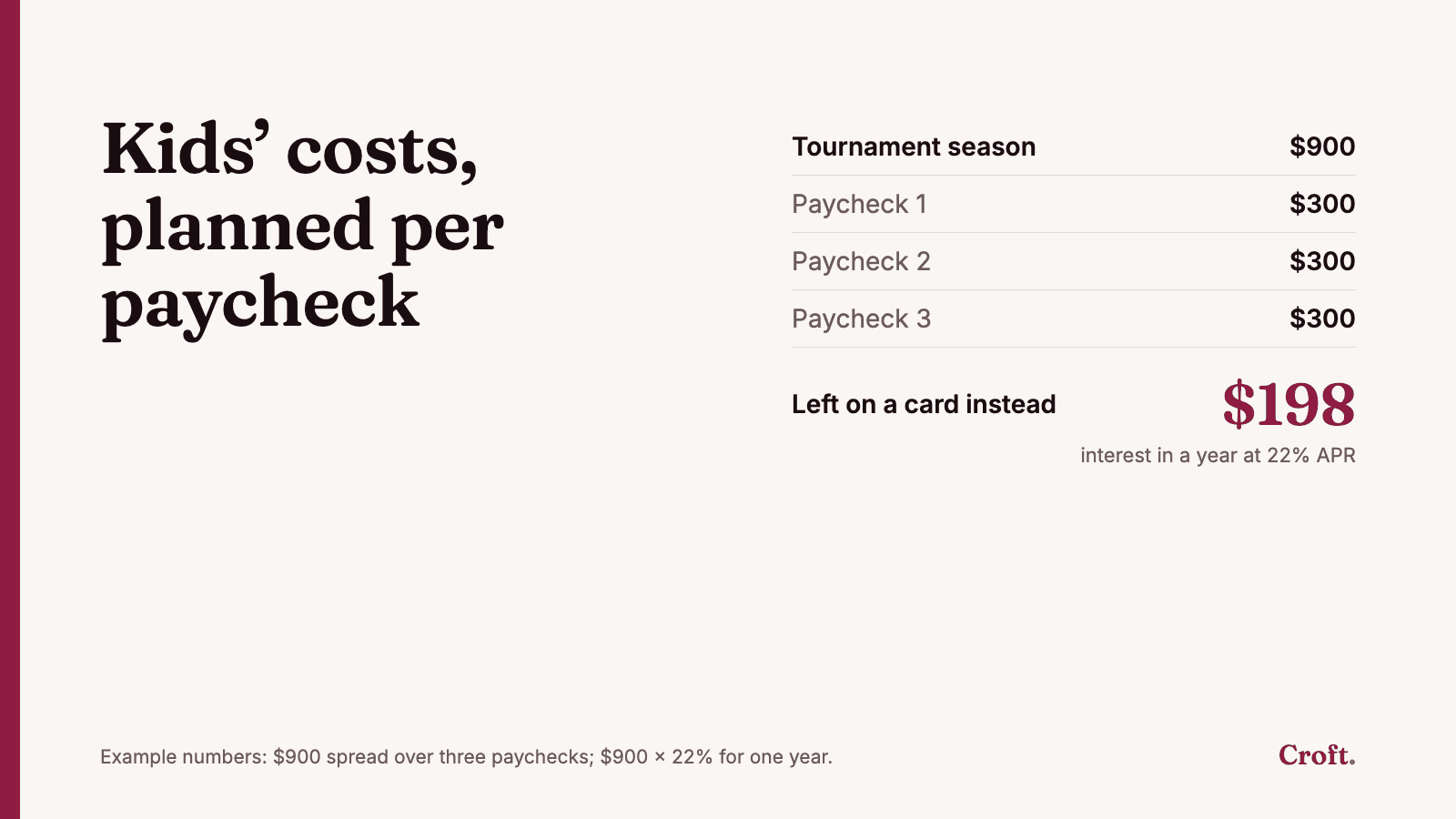
For a full year of kid costs by season, see kids' costs, planned per paycheck.
What not to do
Don't trust the balance on its own. A balance tells you what's in the account. It doesn't tell you what's already promised before payday.
Don't plan on the month's total. It's useful for the big picture, but it can't show you a bad week.
Don't fill the gap with a pay advance or a cash-advance app. They take the money back out of your next paycheck, which makes the next tight week tighter.
Questions people ask
What is the low point before payday?
It's the lowest your checking balance will reach between now and your next paycheck, after every bill and planned cost comes out. If it's below zero, or below the cushion you want to keep, you have a timing problem to fix before that day arrives.
My budget balances. Why am I still short some weeks?
Because a budget counts the month, and bills come out on days. If your biggest bills land in the same two weeks, the first paycheck has to carry them, even if the second paycheck has plenty left.
How big should my cushion be?
Big enough that one surprise doesn't push you below zero. Start with a number you can reach, like one week of groceries and gas, and grow it over time.
Should I put the tournament fee on a credit card to get through the week?
Only if you can pay it in full by the due date. If it stays on the card, you pay interest on a fee you could have planned for. Setting the money aside one paycheck early is cheaper.
The short version
Your month can add up and still have a bad week. Walk your balance forward to your next payday, find the low point, and fix the week before it starts: set a cost aside early, push one past payday, or move a due date.